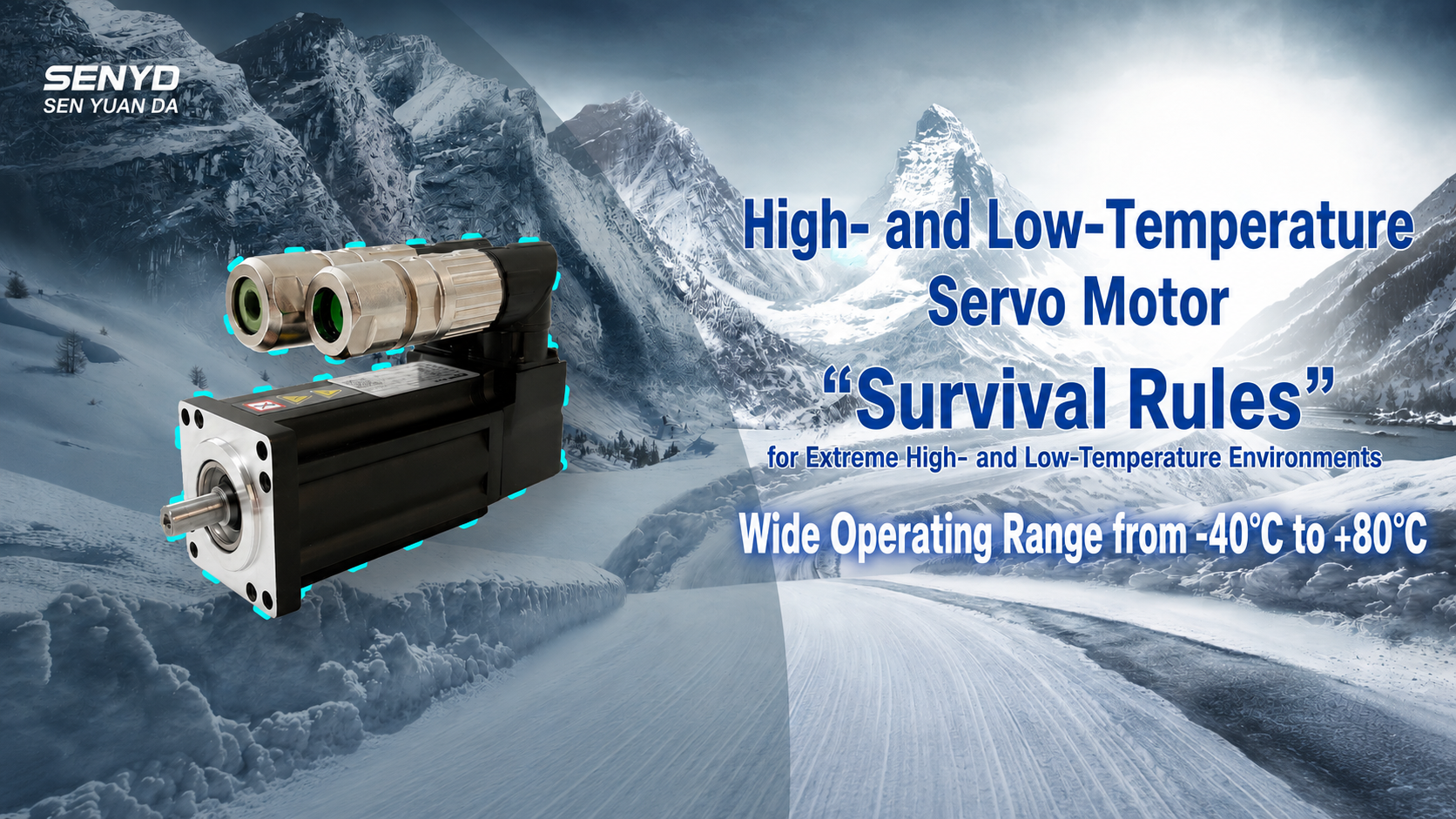
In extreme industrial automation environments—whether on snowy streets or in scorching deserts—servo motors are subjected to severe survival challenges. Conventional electric motors would long have “given up” under such conditions, whereas high- and low-temperature servo motors can operate stably within a range of -40°C to +80°C. This is not accidental, but the result of a strict and precise engineering system—a set of true “survival rules.”
1. “Armor” Against Cold and “Core” Against Heat
Special Magnetic Materials and Windings
The “heart” and “skeleton” of the motor must withstand extreme thermal stress and repeated heating-cooling cycles.
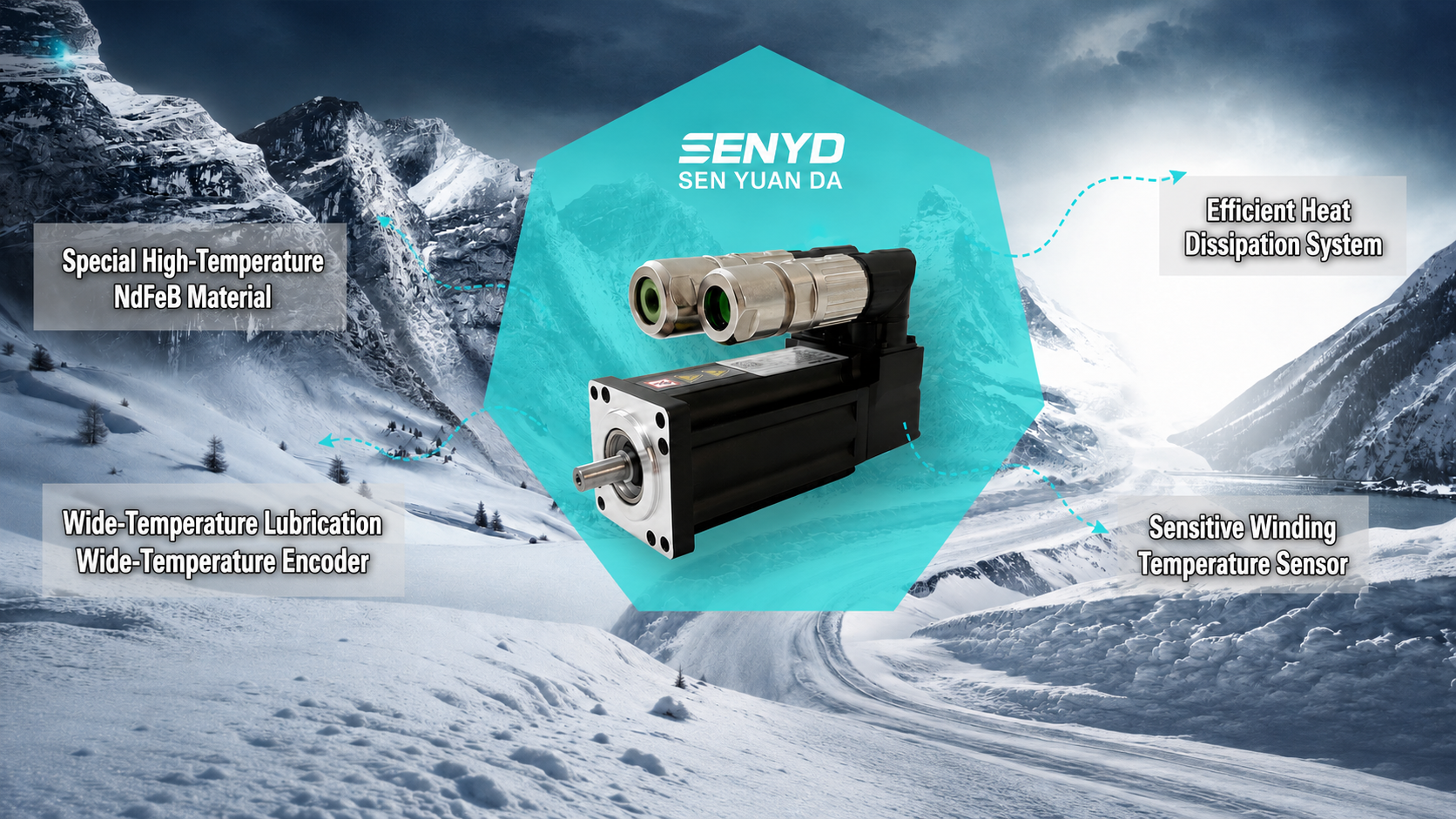
1. Special Magnets: a Robust “Heart” Resistant to Demagnetization
The power source of a servo motor lies in its permanent magnets. Conventional neodymium magnets are prone to irreversible demagnetization at high temperatures, typically above 80°C. This leads to a sharp reduction in torque and effectively causes “cardiac failure” of the motor.
Solution used in high- and low-temperature servo motors:
High-temperature-resistant NdFeB magnets:
By adding heavy rare-earth elements such as dysprosium and terbium, the coercivity of the material is significantly improved, meaning its resistance to demagnetization is greatly enhanced. As a result, the magnets can maintain strong magnetic performance even at 100°C and up to 150°C.
2. Robust Insulation: “Fireproof Clothing” for the Motor’s Nervous System
The windings of the motor act like a sensitive “nervous system,” while the insulation system serves as its protective barrier. High temperature is the primary enemy of insulating materials.
In high- and low-temperature servo motors, insulation systems of Class H (180°C) or even higher, such as Class C (above 220°C), are used. This includes not only heat-resistant insulating varnishes such as modified polyetherimide, but also a complete protective system comprising:
Corona-resistant enameled wire:
Provides resistance to high-frequency pulse stress.
Inter-layer insulation paper:
Maintains high dielectric strength even at elevated temperatures.
Impregnating insulating varnish:
Firmly binds the windings into a dense protective structure, forming a solid “armor.” It effectively protects against moisture and vibration, and reduces the risk of short circuits caused by condensation during alternating high- and low-temperature cycles.
2. “Flowing Blood” and “Sensitive Eyes”
Special Lubrication and Brushless Feedback Sensor
The stability of moving components is the foundation of precise motor motion.
3. “Flowing Blood”: Wide-Temperature Special Lubrication
Bearing grease is like the “blood” of the electric motor, and its condition directly affects service life. Conventional grease can thicken at low temperatures, effectively turning into “paste,” which increases starting torque. At high temperatures, it oxidizes, leaks, and causes dry friction in the bearings, eventually leading to failure.
Wide-temperature grease is a specially developed solution for extreme temperature variations:
At extreme cold conditions of -40°C, it maintains excellent fluidity, ensuring smooth and easy motor startup.
At +80°C and even higher temperatures, it features a high viscosity index and excellent oxidation resistance. It does not leak, does not carbonize, and remains firmly attached to the bearing surface, forming a durable lubricating film.
4. “Sensitive Eyes”: Wide-Temperature Feedback Sensor — Resolver
An encoder is the “eyes” of the electric motor, informing the drive of the rotor position. However, in extreme environments, common optical encoders are often too fragile. Therefore, for harsh conditions, the resolver (rotary transformer) is a more reliable choice.
It operates based on a brushless transformer principle, contains no optical components, and inherently offers several advantages:
High temperature resistance — capable of operating above 125°C.
Excellent resistance to vibration and shock.
Strong protection against dust, moisture, and corrosion.
Although a resolver may be slightly less accurate than high-end optical encoders, its outstanding durability and reliability make it a truly “reliable pair of eyes,” ensuring continuous operation of equipment in extreme environments.
3. The “Art of Breathing”: Active Thermal Management
Motor Cooling System
Even with the most robust internal materials, active cooling remains essential for motor survival.
5. Thermal Management: Efficient Cooling System Design
The main heat sources in electric motors are copper losses and iron losses. We design thermal management systems for motors with the same level of precision as automotive engine cooling systems.
Natural cooling and air cooling:
Through a well-designed housing with cooling fins, the heat dissipation area is increased, allowing heat to be removed via natural air convection. A rear-mounted fan can also be used for forced air cooling. This is the most economical and widely used solution.
Liquid cooling:
In cases of ultra-high power density or extremely high temperatures, the motor can be equipped with a “water jacket.” Cooling channels are designed inside the housing, allowing circulating coolant to rapidly remove heat from key components. This solution is significantly more efficient than air cooling.
In essence, this is equivalent to equipping the motor with its own “central air-conditioning system,” allowing it to operate continuously under rated load while maintaining a stable and low operating temperature.
.END.