You might not expect it, but in the microscopic world of chip manufacturing, in the vast journey of space exploration, and even in high-precision optical coating processes, every precise motion relies on a critical component—the vacuum motor. It acts like a “precision heart” in extreme environments, operating accurately inside an invisible vacuum chamber.
SENYD, a breakthrough representative brand of domestic vacuum motors, is building a solid reputation in the field of special motors with strong technical accumulation and outstanding product performance. This article will start from the requirements of vacuum environments and provide a step-by-step analysis of SENYD vacuum motor design concepts, core technologies, product parameters, and application scenarios.
1. How “unfriendly” is the vacuum environment to motors?
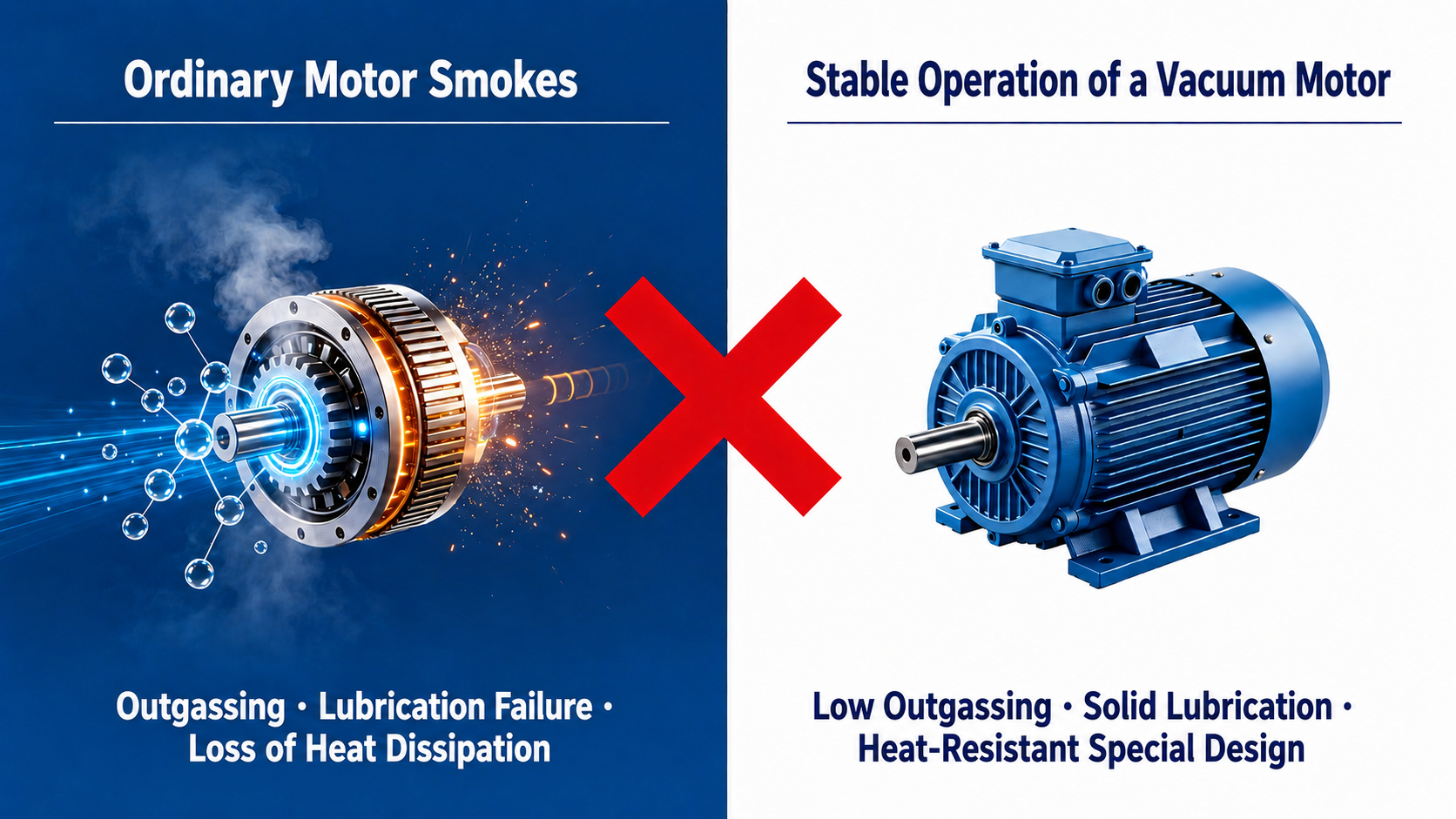
A vacuum environment is very different from the normal atmospheric conditions we live in. Air is extremely thin, and conventional motors often struggle to operate properly, facing three major challenges:
Challenge 1: Heat dissipation difficulty
Conventional motors rely on air convection for cooling. A fan blows, and heat is carried away by airflow. However, in a vacuum, air molecules are extremely scarce, and convective heat transfer is almost completely ineffective. Heat can only dissipate slowly through conduction and radiation. If heat is not removed in time, the winding temperature of the motor will rise rapidly, even exceeding the thermal limit of the insulation materials.
Challenge 2: Material outgassing
Organic materials inside conventional motors—such as enamel insulation on wires, plastic components, and adhesives—continuously release water vapor and hydrocarbons in a vacuum. This phenomenon is known as “outgassing.”
Although these emissions may seem minimal, they are extremely harmful in vacuum environments. In semiconductor wafer processing or optical coating applications, even trace amounts of outgassing can lead to the rejection of entire production batches.
Challenge 3: Lubrication failure
The lubricating grease used in conventional motor bearings contains base oils that evaporate quickly in vacuum conditions. What remains is a dried and hardened thickener, which becomes abrasive particles, accelerating wear and potentially causing bearing seizure.
Faced with these “three major challenges,” conventional motors can hardly operate for long—they experience torque degradation, insulation aging, and bearing failure. In industrial production, this can result in serious losses. Therefore, vacuum environments require motors specifically designed for vacuum operation.
2. How SENYD “tames” the vacuum environment
The SENYD brand carries out full-chain independent R&D—from materials science and thermal management design to control algorithms—to systematically overcome the challenges mentioned above.
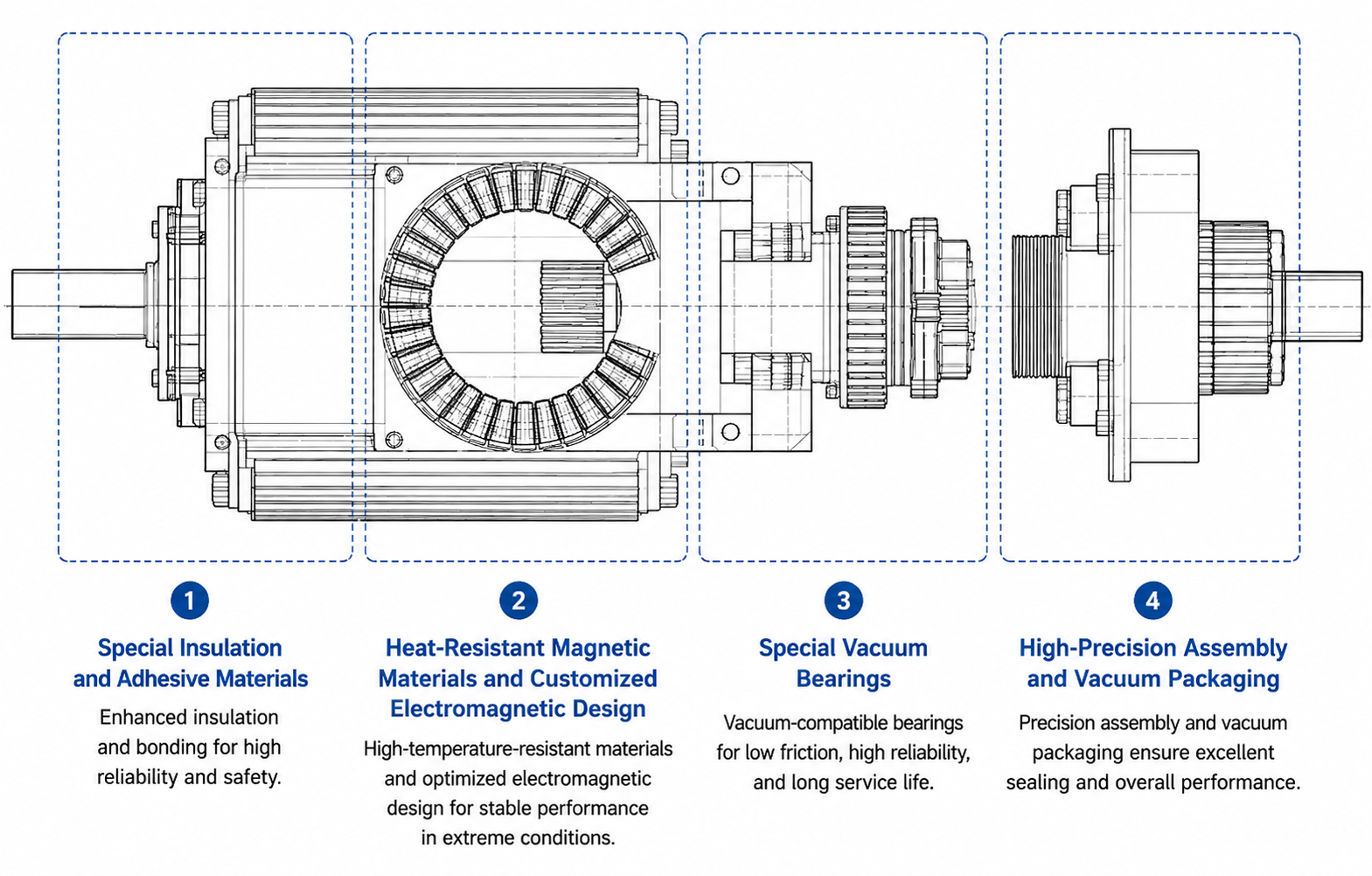
1. Low outgassing material system: eliminating contamination at the source
SENYD vacuum motors use specially formulated adhesives and insulation materials. All adhesive-related processes in production are independently developed with custom formulations to meet stringent requirements for temperature resistance, mechanical strength, thermal conductivity, and outgassing rate.
Critical components undergo thorough vacuum high-temperature degassing treatment before assembly, ensuring that the motor will not contaminate the customer’s vacuum chamber due to outgassing during operation.
2. High-temperature-resistant magnetic materials and advanced electromagnetic design
In vacuum environments, heat dissipation is severely limited, causing internal motor temperatures to be significantly higher than in conventional motors. SENYD uses specially developed magnetic materials with excellent high-temperature resistance.
Combined with innovative electromagnetic design—optimized rotor, stator, and winding structures—the motor can maintain stable torque output under high steady-state temperatures without demagnetization.
In contrast, conventional motors typically use standard neodymium iron boron (NdFeB) magnets, which generally withstand temperatures up to around 120°C. SENYD vacuum motors, however, can operate reliably across an extreme temperature range from -196°C to +200°C under stable conditions.
3. Special bearing and lubrication solutions
SENYD collaborates with professional bearing manufacturers to develop vacuum-rated special bearings. These components are produced under equally stringent standards, ensuring high reliability, sufficient design margins, and longer service life.
4. High cleanliness assurance
Through carefully selected materials and a comprehensive post-processing process, SENYD vacuum motors deliver excellent performance even in high-cleanliness environments. The entire production process is maintained under clean conditions, and all products undergo cleaning treatment followed by vacuum packaging to ensure high cleanliness upon delivery.
3. SENYD vacuum motor product series and core specifications
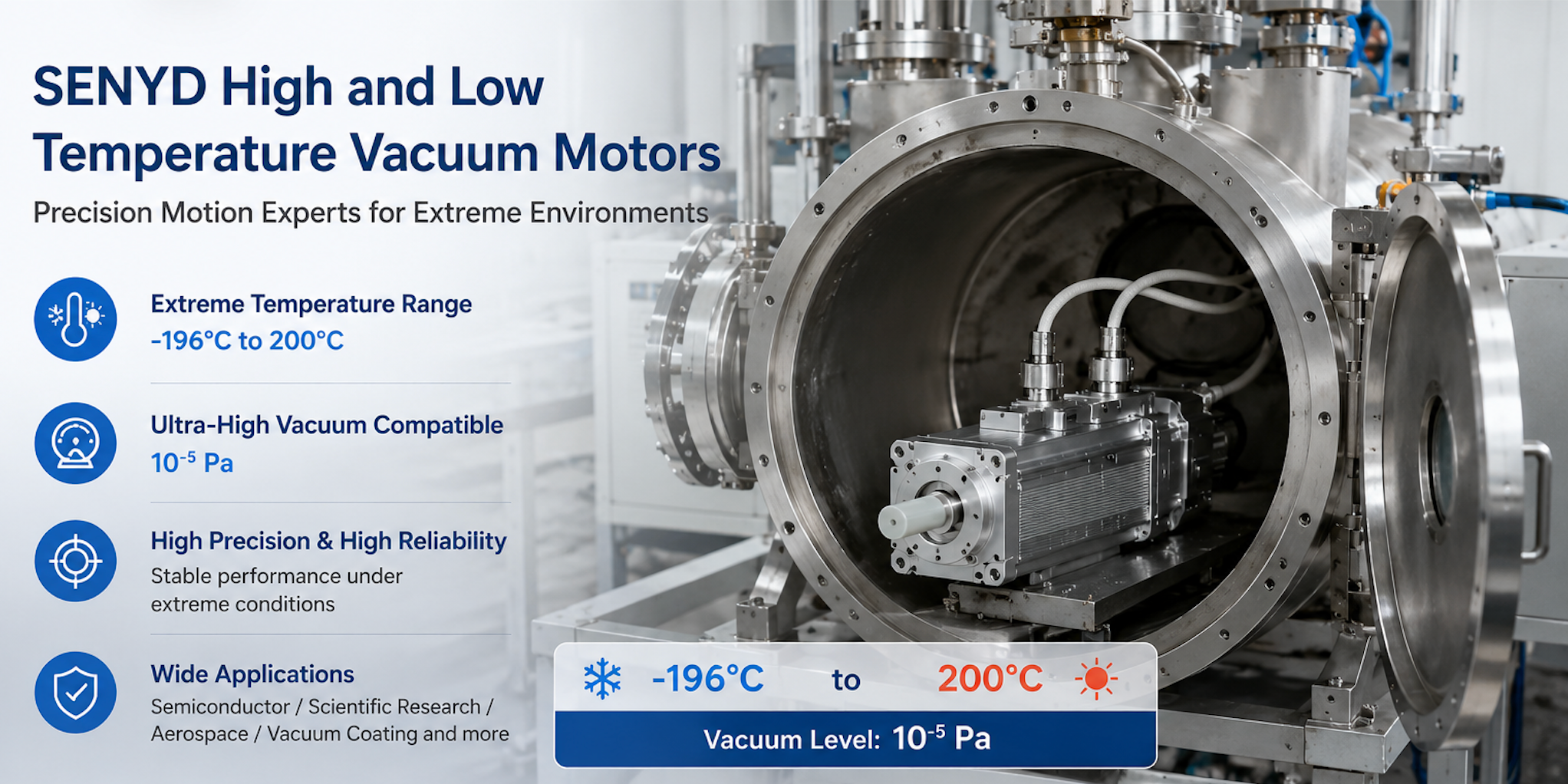
SENYD vacuum motors are mainly divided into two series: the SYDH high & low temperature vacuum stepper motor series and the SYDH high & low temperature vacuum servo motor series, covering different motion control requirements.
(1) SYDH high & low temperature vacuum stepper motor
The SYDH vacuum stepper motor adopts a completely new design, using optimized materials and advanced manufacturing processes for the production and inspection of specialized motors.
Application environment: Vacuum, high temperature, low temperature
Vacuum level: Better than 1.0 × 10⁻⁵ Pa
Temperature range: -196°C to +200°C
Motor type: Two-phase, four-wire hybrid stepper motor
(2) SYDH high & low temperature vacuum servo motor
The SYDH vacuum servo motor is designed for applications requiring high-precision closed-loop control and high dynamic response.
Application environment: Vacuum, high temperature, low temperature
Vacuum level: Better than 1.0 × 10⁻⁵ Pa
Temperature range: -196°C to +200°C
Power range: 50 W to 5.5 kW
4. Application scenarios: where vacuum motors truly excel
SENYD vacuum motors have been widely applied in multiple high-end fields, covering diverse scenarios from scientific research to industrial production.
1. Semiconductor manufacturing
Used in wafer transfer robotic arms, etching equipment, and vacuum coating systems (PVD/CVD), where vacuum motors enable precise motion in ultra-clean environments.
2. Aerospace and space technology
Including satellite attitude adjustment mechanisms, space environment simulation systems, and rocket fuel valve control. With extreme temperature variations and radiation exposure in space, SENYD vacuum motors—featuring a wide temperature range from -196°C to +200°C and customizable radiation-resistant solutions—are well suited for such harsh conditions.
3. Scientific research equipment
Such as particle accelerators, nuclear fusion experimental systems, and electron microscopes. These systems require stable motor operation under ultra-high vacuum and wide temperature ranges. Vacuum stepper motors with oil-free or solid lubrication designs are ideal for such ultra-high vacuum research environments.
4. Optical and coating industry
In vacuum coating equipment, every rotation of the motor directly affects film uniformity, which ultimately determines the performance of optical components.
5. Biomedical applications
Including cryo-electron microscopy (Cryo-EM), low-temperature biological sample storage, and cryogenic experimental systems, all of which require strict cleanliness and precise temperature control.

Conclusion
Vacuum motors represent a niche field with “high technical density but low user visibility”—most people are unaware that inside chips, spacecraft, and scientific instruments, these specialized motors silently support critical processes.
With strong in-house R&D capabilities and deep understanding of extreme operating conditions, SENYD has established a leading position in this field in China. Whether you are a semiconductor equipment manufacturer, a research institution, or an aerospace engineer, the SENYD SYDH vacuum motor series is a reliable and trustworthy domestic solution.