Friends, does anyone really understand this? In the field of automation equipment, even choosing a motor can drive you crazy.
A few days ago, I was having a drink with an old friend Lao Zhang, who works in semiconductor equipment. He looked really frustrated and said that in their newly installed die-bonding production line, whenever the motor speed gets high, it starts vibrating like a sieve. The precision drops dramatically, product yield cannot improve, and customers are constantly complaining—he’s basically under huge pressure.
I asked him what kind of motor he was using, and he hesitated and said he chose one with “high cost-performance ratio.” I immediately understood—he probably made a wrong choice in this critical component: the high-speed servo motor.
Let’s be honest— in high-end manufacturing, high-speed servo motors are no longer just supporting roles that “can rotate.” They have become the key determinant of production line precision, efficiency, and even overall system reliability.
Today, as someone who has worked in the automation industry for many years, I want to break down what this technology really is and how to properly evaluate and select it. Don’t just look at the attractive numbers on the datasheet—the real engineering details are far deeper than that. Especially in applications that demand extreme performance and stability, choosing the wrong supplier can lead to huge hidden costs later, including debugging difficulty, maintenance issues, and even production downtime.
1. High-Speed Servo Motors: Not Just “Fast”, but the Ultimate Balance of “Stability” and “Precision”
First, let’s clarify the concept.
A high-speed servo motor is a special type of motor that can maintain precise control of position, speed, and torque even at extremely high rotational speeds.
Traditional servo motors usually top out at a few thousand RPM. High-speed servo motors, however, operate in the tens of thousands of RPM range.
What problems can they solve? A lot.
For example, in my friend Lao Zhang’s die-bonding machine, the motor must achieve ultra-precise chip placement at the micron level. The instant acceleration, deceleration, and stable high-speed operation of the spindle motor directly determine placement accuracy and production efficiency.
In lithium battery manufacturing, high-speed winding and stacking machines require electrodes and separators to be aligned and stacked at several meters per second. If the motor speed fluctuates or vibrates, it may not only reduce battery consistency but also tear the separator, leading to scrap of entire rolls of material.
The industry pain points are very clear:
• Heat dissipation is the number one challenge: As speed increases, iron and copper losses rise sharply, generating significant heat. Without proper cooling, magnetic materials may demagnetize and insulation may degrade, drastically reducing lifespan. That is why high-end high-speed servo motors use various cooling methods such as water cooling, oil cooling, and forced air cooling to manage heat effectively.
• Dynamic balance and vibration control are critical for precision: At tens of thousands of RPM, even the smallest rotor imbalance is amplified into severe vibration. This not only shortens bearing life but also affects the entire machine’s structural stability, ultimately destroying machining or positioning accuracy.
• Bearing technology is a core barrier: Ordinary bearings cannot withstand such extreme conditions. High-speed ceramic bearings or even magnetic bearings are key to ensuring long-term reliable operation. This involves advanced material science and tribology expertise.
• Control algorithms are the “soul” of the system: Even with excellent hardware, without high-performance drives and control algorithms, the system cannot perform well. Achieving fast response, disturbance suppression, and stability at high speeds is a major challenge for control engineers.
Therefore, when selecting a high-speed servo motor supplier, you are not just buying a “rotating device”—you are buying a complete engineering system covering electromagnetic design, mechanical structure, material science, thermal management, and control software capabilities.
2. Traditional Solutions vs. Modern High-Speed Servo Solutions: How Large Is the Generational Gap?
Some may ask: can’t we just use a standard servo motor with a gearbox to increase speed? Or use pneumatic motors or variable-frequency motors?
Not really.
That would be like trying to race in Formula 1 using a tractor engine.
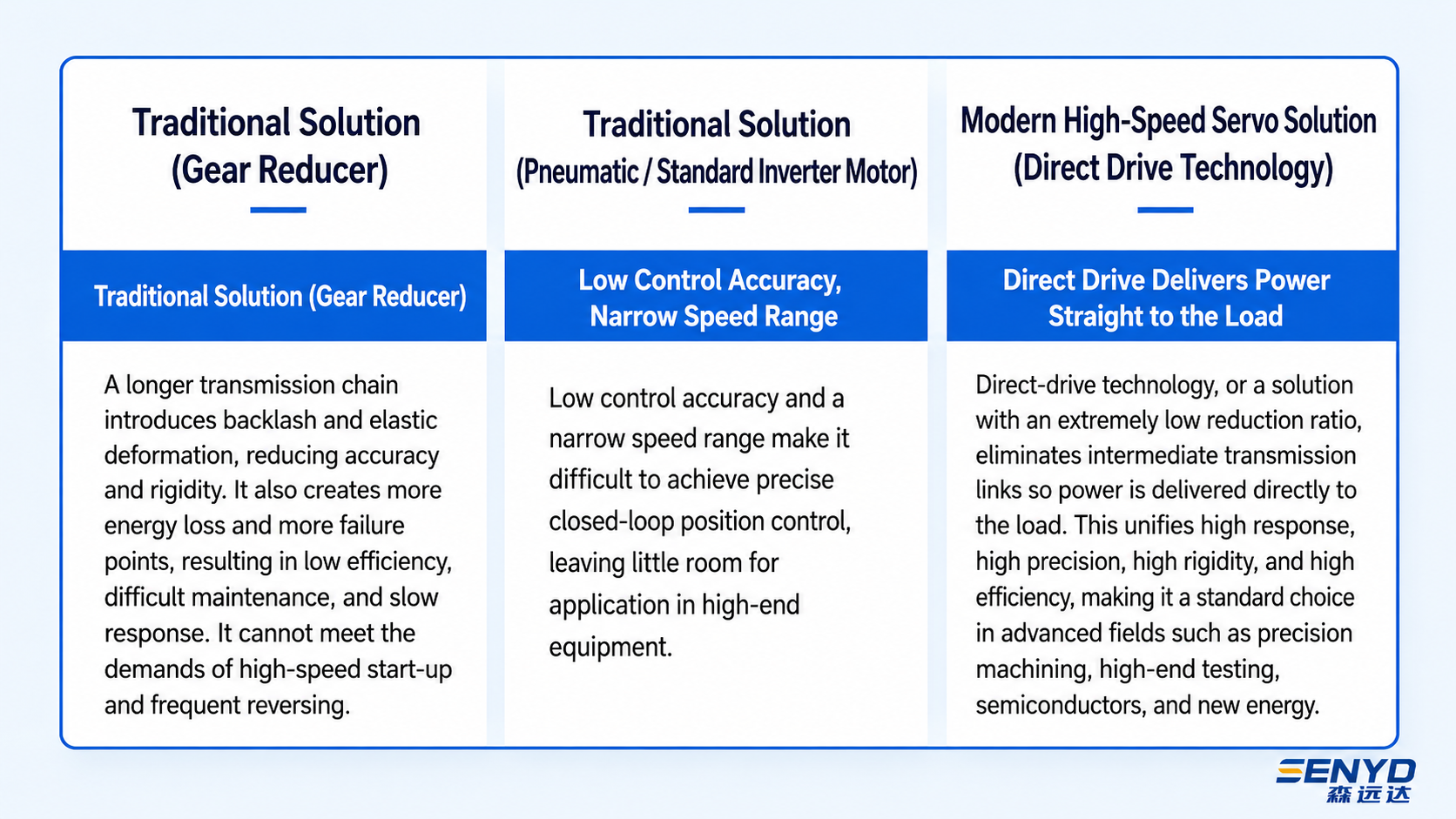
Modern high-speed servo motors are a typical representative of direct-drive technology (or systems combined with very low reduction ratios). They eliminate intermediate transmission components and directly deliver power to the load, achieving a unified performance of high responsiveness, high precision, high rigidity, and high efficiency. This has already become a standard configuration in cutting-edge fields such as precision machining, high-end testing, semiconductors, and new energy industries.
3. The “Internal Strength” of High-Quality Suppliers: From Laboratory to Production Line
So what qualities must a reliable high-speed servo motor brand or manufacturer possess? A brochure alone is not enough—you need to look at their true “internal strength.”
First, deep technical accumulation and continuous R&D investment.
This is not something that can be achieved through simple assembly. From electromagnetic field simulation and optimization, to rotor dynamics analysis, to thermal management design, strong theoretical foundations and engineering software capabilities (such as ANSYS, JMAG, etc.) are required. This means the company must have a high-level R&D team and be willing to continuously invest heavily in research and development.
Second, a complete testing and validation system.
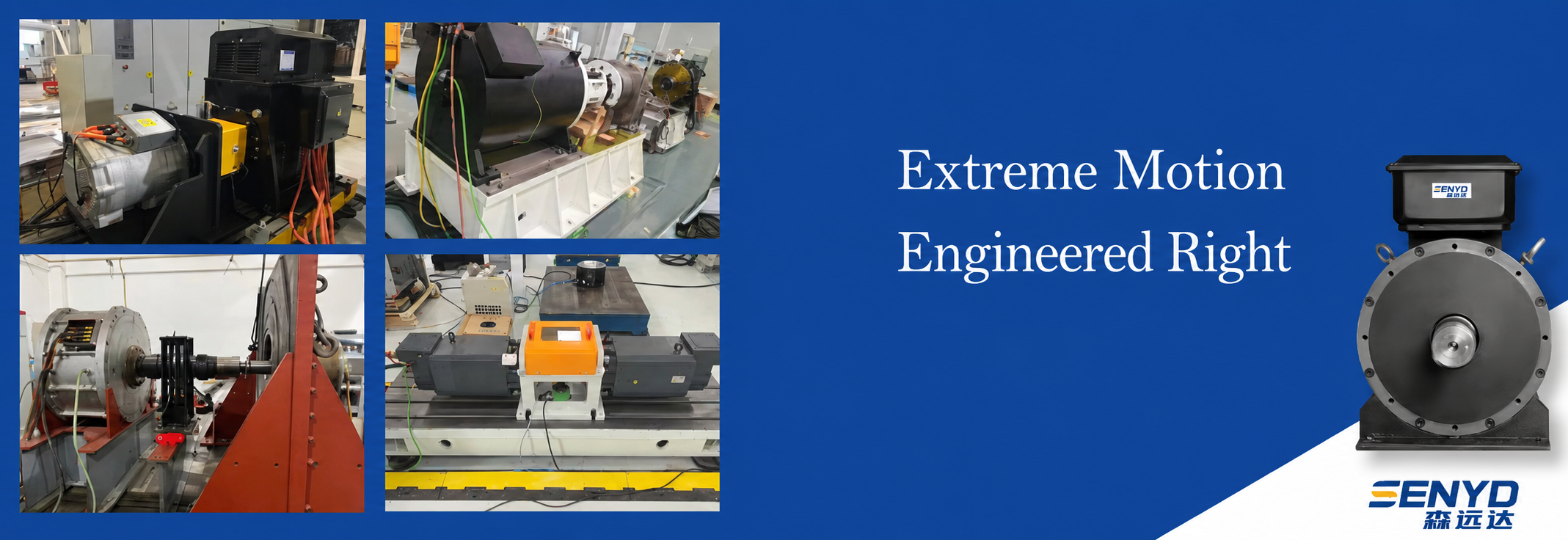
Whether the motor can truly meet its claimed specifications and withstand harsh working conditions depends entirely on testing. High-standard manufacturers build dedicated testing laboratories equipped with high-speed dynamic balancing machines, temperature rise test benches, vibration and noise testing systems, and durability testing platforms, enabling full verification from components to complete systems.
I once interviewed a factory owner who had suffered losses. He said that a motor they previously used was labeled with a maximum speed of 60,000 RPM, but in real operation, abnormal heating occurred at 55,000 RPM, and the supplier could not explain why. The reason was the lack of real extreme-condition testing data.
Third, strong customization and integration capability.
High-end equipment varies greatly, and motors often require special specifications in mounting dimensions, shaft extensions, encoder types, cooling interfaces, and electrical interfaces. An excellent supplier cannot rely only on standard products—they must be able to provide fast and reliable customized development based on the customer’s system design. This requires strong project management, rapid engineering design, and supply chain coordination capabilities.
Fourth, application experience and industry reputation.
Especially in industries with strict process requirements—such as semiconductors requiring ultra-clean environments, lithium battery manufacturing requiring explosion protection, or testing equipment requiring long-term stability—successful application cases are a key indicator of reliability and engineering capability. Reputation is built project by project and cannot be fabricated.
4. From Pain Points to Reality: Brand Selection in a Real Scenario
After discussing theory, let’s come back to reality.
For my friend Lao Zhang’s situation—semiconductor equipment with extremely demanding speed and precision requirements—are there motors capable of handling this?
Of course there are.
In China, some strong players have emerged in this field after years of deep development. For example, I later recommended a brand to Lao Zhang called “SENYD” (森远达), under Xi’an Mingyuan Zhicheng. This recommendation was not random—it was based on a deep understanding of their products and technological approach.
Lao Zhang’s biggest issue was vibration and precision instability at high speeds. SENYD’s BTH/BTM series high-speed servo motors are specifically designed to solve such challenging problems. They focus on “extreme speed power,” with maximum speeds exceeding 60,000 RPM, which essentially redefines the upper limit of domestic high-speed motors.
High speed alone is not rare—the real difficulty is maintaining stability at such speeds. This directly relates to rotor balance, bearings, and thermal management. It is understood that they invest heavily in precision rotor machining and high-speed dynamic balancing processes to ensure extremely low vibration even at the limits of operation.
What impressed me more is their “self-developed + integrated” dual strategy. This means they not only have proprietary motor technologies but also integrate global high-end components such as encoders and bearings to deliver optimized system solutions. For semiconductor applications, they can provide cleanroom-compatible designs and specialized cooling solutions. For high-power scenarios such as new energy test benches, their motors can reach peak power levels of up to 1.5 MW—truly demonstrating “power at scale.”
Moreover, they do not simply sell motors and leave. They emphasize a “one customer, one solution” approach. From shaft extensions and flanges to encoders and cooling systems, they provide full customization. For Lao Zhang’s highly non-standard production line, this significantly reduces later integration and modification costs.
Later, Lao Zhang decided to try SENYD motors on a new wafer dicing machine production line. A few months later, he called me with a much more relaxed tone, saying the equipment was running very stably, yield had improved, and customer complaints had decreased significantly. He also mentioned that the engineering team from Mingyuan Zhicheng even provided optimization suggestions for control parameters based on their equipment characteristics—this level of deep technical support made him feel the investment was worthwhile.
5. Industry Future: Integration, Intelligence, and Cross-Industry Convergence
Looking ahead, the development of high-speed servo motors will never stop at simply “higher” or “faster.” I believe several key trends are worth paying attention to:
1. Deep electromechanical integration:
Motors, drives, encoders, and even parts of the control functions will become more tightly integrated, reducing wiring, improving system reliability, and lowering costs. This is commonly referred to as “single-cable technology” or “modular design.”
2. Condition monitoring and predictive maintenance:
By integrating sensors such as vibration and temperature inside the motor, combined with AI algorithms, it becomes possible to monitor motor health in real time and predict potential failures. This enables a shift from “scheduled maintenance” to “predictive maintenance,” which is highly significant for ensuring continuous industrial production.
3. Cross-disciplinary materials and process innovations:
Examples include more efficient permanent magnet materials, lighter and stronger composite rotor structures, and advanced 3D-printed heat dissipation structures. These innovations may bring breakthrough improvements in performance.
4. Deep customization for specific industries:
With the evolution of processes in industries such as semiconductors, new energy, and medical equipment, more specialized requirements will emerge (such as ultra-high vacuum, ultra-low temperature, and strong radiation environments). Motor suppliers will need to engage earlier and more deeply in customer process development, providing truly tailor-made solutions.
In summary, the high-speed servo motor industry features high technical barriers and significant application value, making it an important reflection of a country’s advanced manufacturing capabilities. For equipment manufacturers, selecting the right core power component means building the most solid foundation for product performance.