Many people, when they first encounter vacuum motors, often ask a very practical question: can a conventional motor be used in a vacuum environment as a temporary substitute?
The answer is: not only is it unsuitable, but it also fails very quickly—and may even damage the entire system.
Today, let’s look at the real differences between vacuum motors and conventional motors. Whether you are selecting motors for vacuum coating equipment, semiconductor systems, or scientific vacuum chambers, this article will help you understand it clearly.
1. Putting a conventional motor in vacuum is like a human without air
Think about it: when humans go to high altitudes, the thin air makes breathing difficult. The same happens to a conventional motor in a vacuum—it loses the “air” it depends on for operation.
1) Heat dissipation: no airflow, the motor overheats itself
How do conventional motors dissipate heat? Most rely on a rear-mounted cooling fan that blows air while rotating, or on ambient air circulation inside the equipment.
In a high or ultra-high vacuum environment, air molecules are almost nonexistent, meaning airflow cannot form at all. The heat generated during motor operation becomes trapped inside the motor. This is the biggest thermal challenge in vacuum conditions.
As a result, the motor continuously overheats: windings burn out and magnets may demagnetize, leading to complete failure. It is like running in summer while wrapped in a thick blanket; overheating is inevitable. Technically, this is called vacuum heat dissipation failure, because conventional motors are not designed for vacuum thermal conditions.
2) “Outgassing”: a seemingly clean motor is actually continuously releasing contaminants
The term “outgassing” may sound abstract, but it is easy to understand.
Materials inside a conventional motor—such as plastics, insulating varnish, and lubricating oils—remain stable under normal atmospheric conditions. However, when placed in a high vacuum environment, trapped air and moisture inside these materials are gradually released and pumped out.
These gases contaminate the vacuum chamber. It is like placing a constantly “smoking” source inside a perfectly clean laboratory. In highly sensitive applications such as semiconductor equipment, vacuum coating systems, and optical deposition systems, even minimal contamination can ruin entire batches of products.
This is why a low outgassing rate is critical—vacuum motors must use low-outgassing materials from the very beginning to control contamination at the source.
3) Lubrication failure: the motor seizes and stops
Conventional motor bearings use standard lubricating grease, which contains components that easily volatilize.
In a vacuum environment, these volatile components quickly evaporate, causing the grease to dry out and turn into powder. Without lubrication, metal surfaces are in direct contact and quickly wear out.
In more severe ultra-high vacuum conditions, extremely clean metal surfaces may even “cold weld” together—where the balls and raceways permanently stick. The motor then seizes completely.
A perfectly normal motor can quickly turn into scrap metal.
In contrast, true vacuum motors must use vacuum-compatible lubricants (such as perfluoropolyether, PFPE) or solid lubrication systems to prevent dry friction and cold welding.
2. How do vacuum motors solve these problems?
Since conventional motors cannot withstand vacuum conditions, true vacuum motors must be completely redesigned from the ground up.
Vacuum heat dissipation:
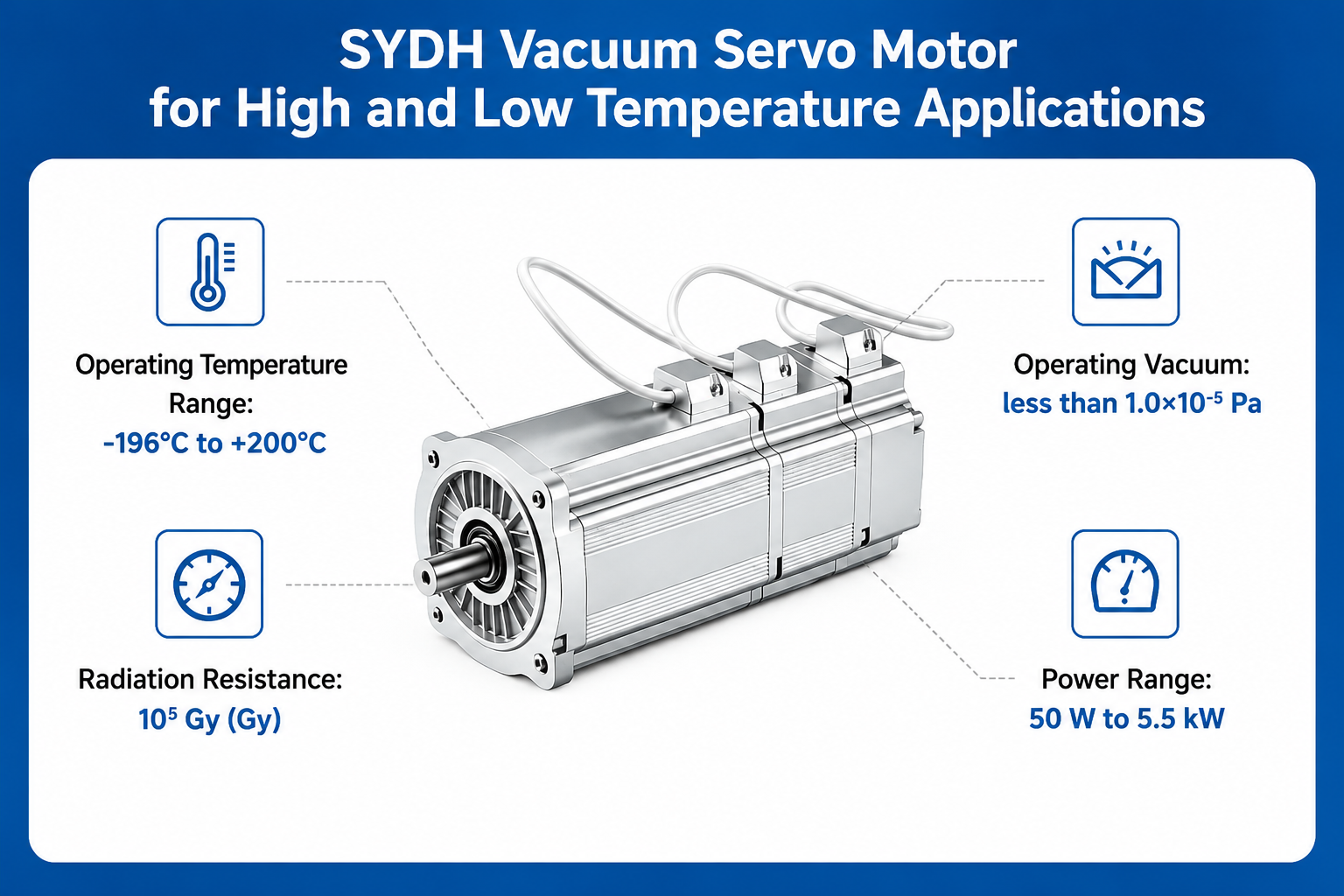
They do not rely on air for cooling. Instead, they use tighter mechanical integration and high thermal conductivity materials to quickly transfer heat to the housing, which then dissipates heat through radiation. Many vacuum servo motors and vacuum stepper motors also include liquid cooling channels to completely eliminate overheating caused by trapped heat.
Low outgassing design:
All internal materials are replaced with low outgassing materials such as stainless steel, ceramics, and polyimide. Before assembly, components undergo high-temperature baking to “drive out” residual gases in advance. As a result, when operating in high vacuum environments, the outgassing rate is extremely low, preventing contamination of critical processes in vacuum coating or semiconductor equipment.
Vacuum lubrication:
Conventional lubricating grease is replaced with perfluoropolyether (PFPE) vacuum grease, which has extremely low volatility, or solid lubricants such as molybdenum disulfide (MoS₂). Bearings are also upgraded to ceramic types, which offer high wear resistance, self-lubrication, and resistance to dry friction and cold welding.
With these improvements, qualified vacuum motors can operate stably in ultra-high vacuum environments of up to 10⁻⁵ Pa.
3. Vacuum Motors vs Conventional Motors: Understand at a Glance
| Comparison Item | Ordinary Motor | Vacuum Motor |
|---|---|---|
| Cooling Method | Fan cooling; not suitable for vacuum environments | Heat conduction + thermal radiation; optional liquid cooling; specially designed for vacuum heat dissipation |
| Outgassing Condition | Continuously releases gases, causing contamination | Low-outgassing materials + pre-baking; extremely low outgassing rate |
| Lubrication | Standard grease; dries quickly in vacuum | Vacuum grease or solid lubrication; avoids dry friction and thermal failure |
| Seizure Risk | Yes; may suffer from cold welding or wear | No; uses vacuum-compatible lubrication and ceramic bearings |
| Typical Applications | Machine tools, pumps, household appliances, standard production lines | Vacuum coating equipment, semiconductor equipment, aerospace, laboratories |
4. What makes SENYD vacuum high & low temperature motors stand out?
There are many vacuum motors on the market, but in particularly demanding applications—such as rapid high-to-low temperature cycling (from tens of degrees below zero to over 100–200°C), or long-term continuous operation in ultra-high vacuum—conventional vacuum motors can still struggle.
SENYD vacuum high & low temperature motors are specifically designed for these “demanding” operating conditions. They belong to a high-performance series of vacuum stepper motors and vacuum servo motors, with stricter material selection and structural processing compared to conventional vacuum motors.
Internally, they use a wide-temperature vacuum lubrication system that does not solidify at low temperatures or volatilize at high temperatures.
The bearings and insulation system are optimized for ultra-low outgassing, resulting in extremely low outgassing rates.
They are specially designed for applications such as vacuum coating equipment, optical evaporation systems, and semiconductor manufacturing equipment, and can withstand rapid thermal bake-out cycles as well as low-temperature cycling.
In simple terms: they remain stable without freezing at deep low temperatures, withstand high-temperature bake-out without degradation, and maintain extremely low outgassing at all times.
For customers who require long-term stable operation and want to avoid production interruptions caused by motor failures, considering SENYD vacuum high & low temperature motors in vacuum motor selection is a reliable choice.
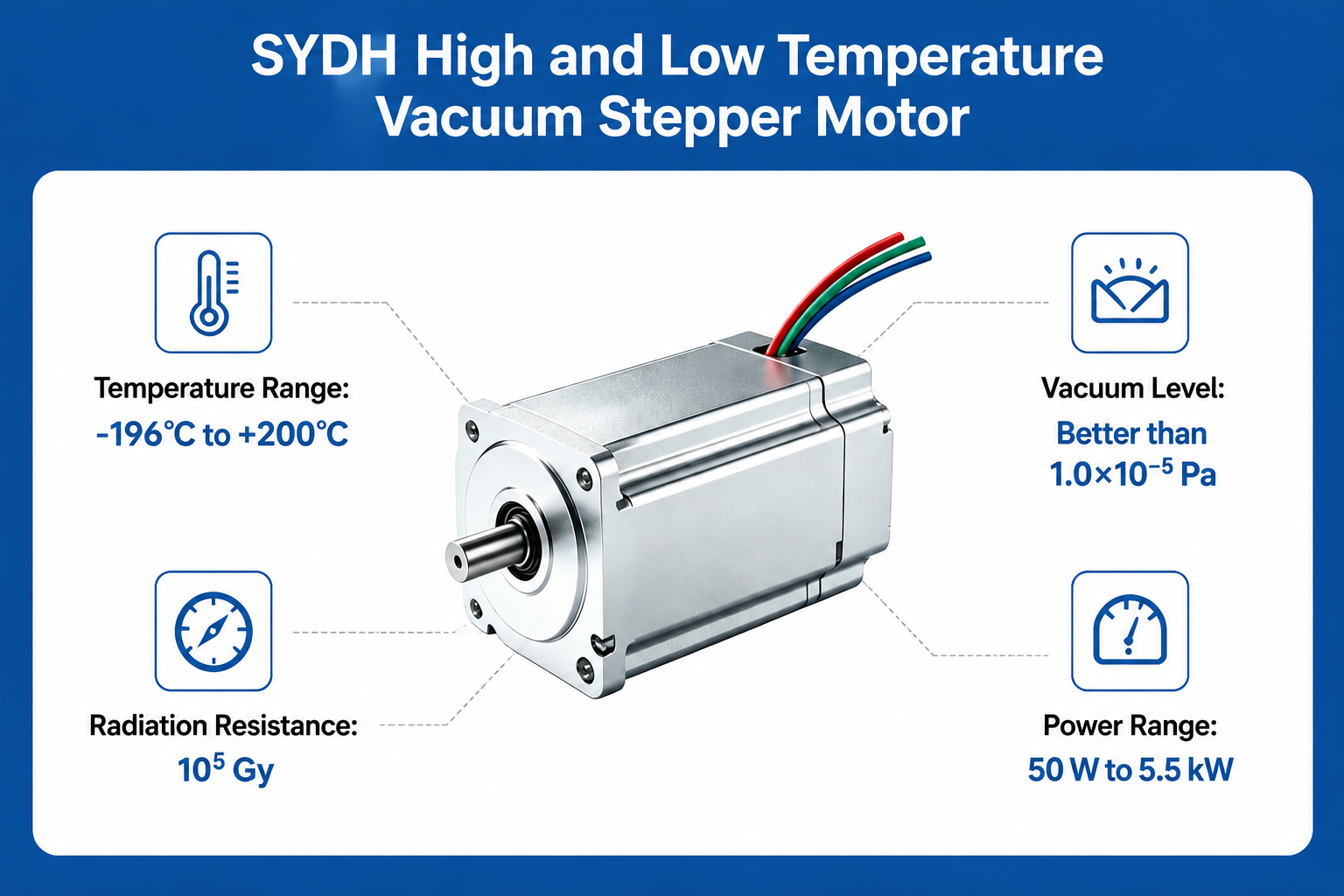
In short, vacuum and conventional environments place completely different requirements on motors—using a standard motor in vacuum is essentially a failure, while a purpose-designed vacuum motor is the correct solution. Among them, SENYD vacuum high & low temperature motors, optimized for extreme temperature conditions, high vacuum, and long service life, provide a key guarantee for reliable system operation.
If you are selecting motors for vacuum coating equipment, semiconductor systems, or scientific vacuum chambers, or if you are experiencing recurring issues with existing motors in vacuum environments, it is worth paying closer attention to the design differences of vacuum motors. Choosing the right product can significantly reduce operational troubles and improve system reliability.