What is a high-speed servo motor?
A high-speed servo motor is a precision motor operating under a closed-loop servo control system, capable of reaching rotational speeds exceeding 10,000 rpm, with some models even achieving up to 200,000 rpm. It combines two key characteristics: extremely high rotational speed and millisecond-level precise control of position, speed, and torque.
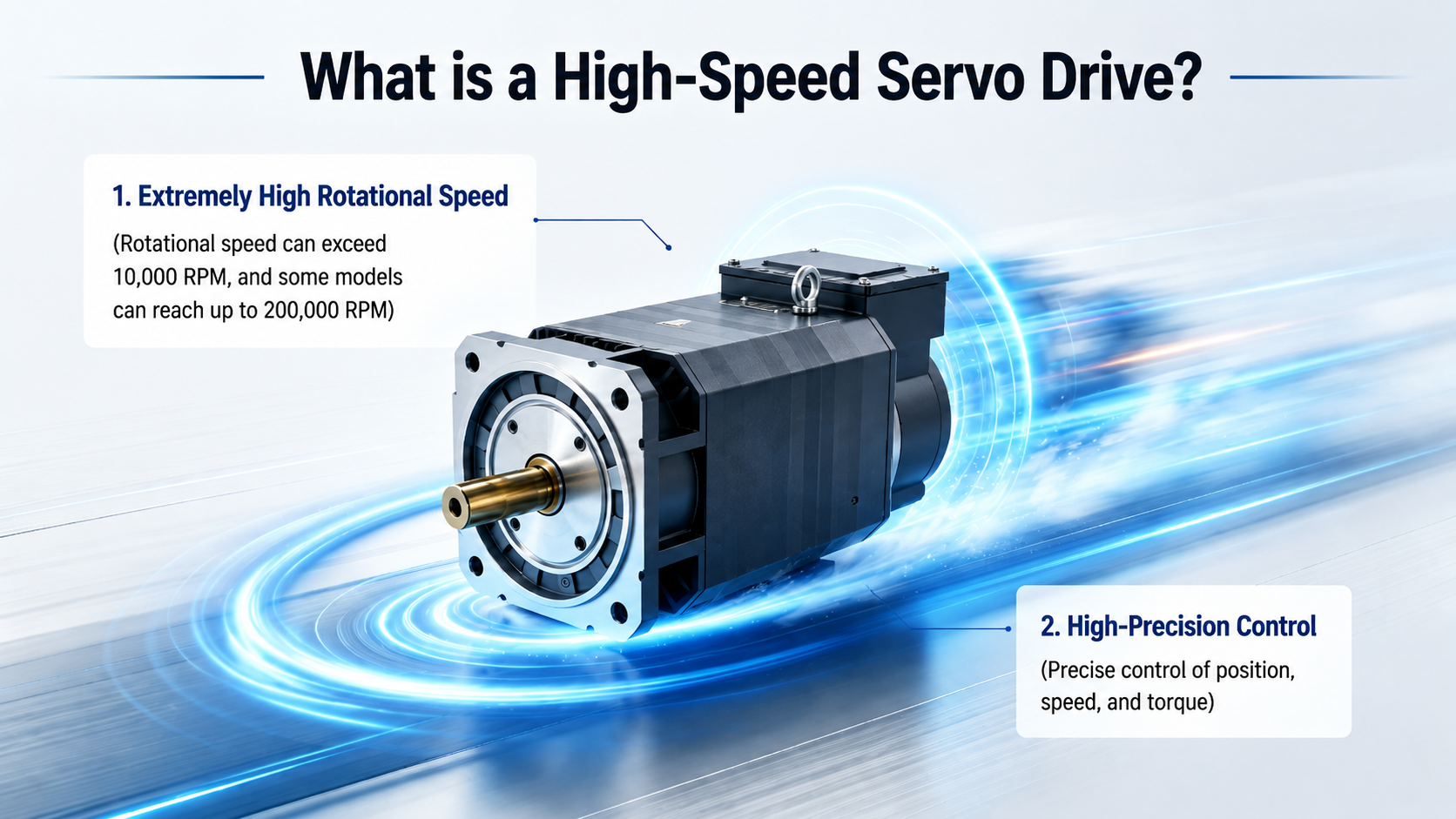
Key Differences from Conventional Servo Motors
Conventional servo motors primarily focus on accuracy and positioning precision, but have limited capability in achieving higher rotational speeds. In contrast, high-speed servo motors take precision as a foundation and push speed performance to the extreme. To achieve this, they typically adopt ultra-low inertia rotors such as slender-shaft or hollow-cup designs, specialized cooling structures (water cooling or oil cooling), and are combined with high-resolution encoders and high-bandwidth drive algorithms. These technologies work together to suppress vibration and heat generation at high speeds, enabling precise dynamic response.
Core Performance Characteristics
Ultra-high speed:
Rated speeds generally exceed 10,000 rpm. High-performance spindle applications can reach 45,000 rpm, while specialized medical applications can even enter the 200,000 rpm range.
High precision and low vibration:
With closed-loop feedback and high-resolution encoders, high-end systems can achieve nanometer-level positioning accuracy. At rated speed, vibration amplitude remains extremely low, ensuring stable machining and operational quality.
High dynamic response:
Ultra-low inertia design enables response times as short as 250 μs. The system supports extremely rapid acceleration and deceleration, often reaching maximum speed from standstill within tens of milliseconds.
High overload capacity and efficiency:
Typically provides 2–3 times electrical overload capability with high power density. Some magnetic levitation direct-drive systems can achieve efficiency up to 98.5%.
Reliable thermal control and long service life:
Water cooling, oil cooling, or potting processes effectively control temperature rise. Combined with precision bearings and dynamic balancing, the system achieves low noise and long operational life.
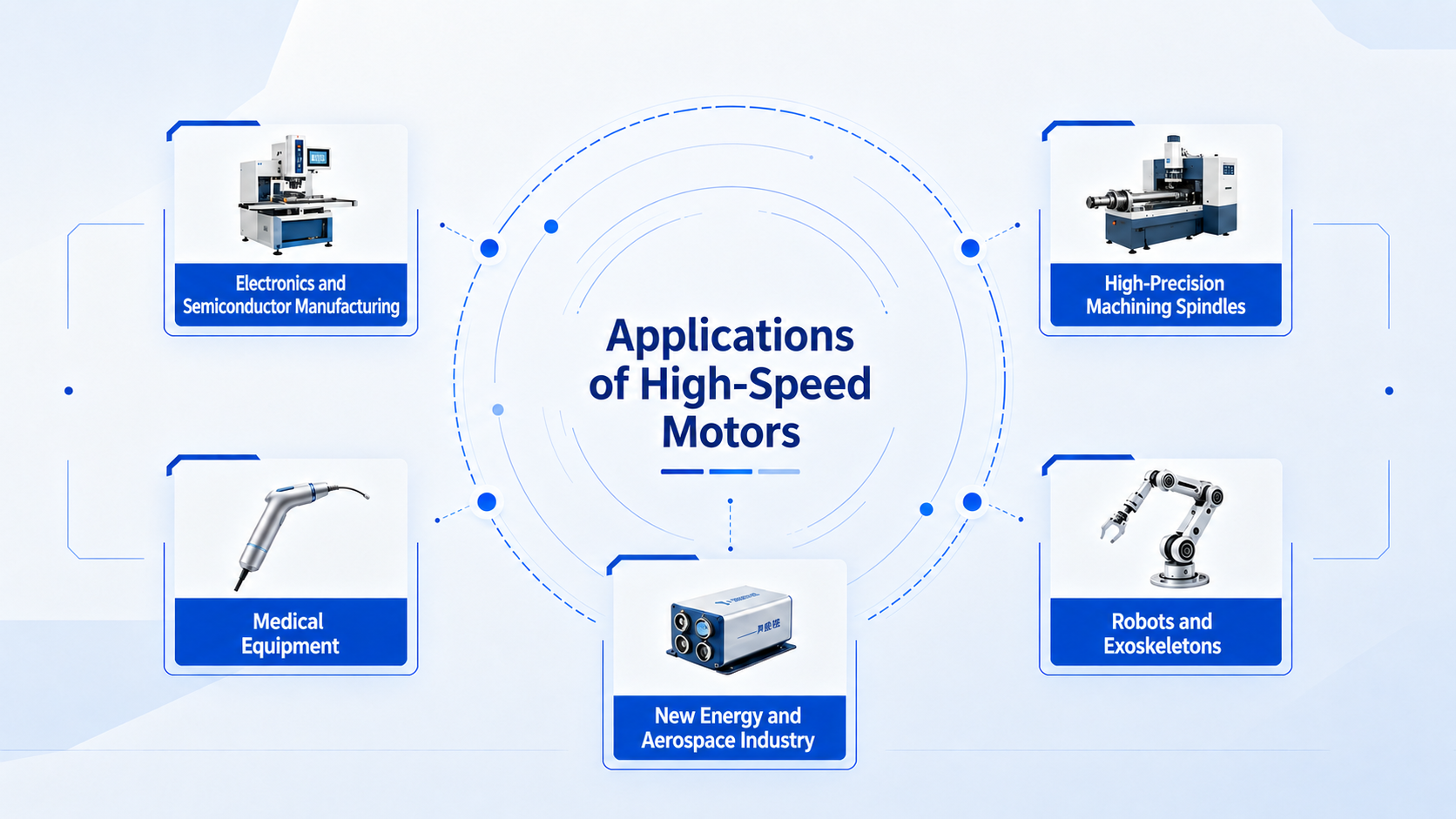
Main Application Fields
3C electronics and semiconductor manufacturing:
Used in pick-and-place machines and wafer dicing equipment, where micro- or nano-level positioning must be maintained under extremely high speed and acceleration conditions. Even minimal vibration or overshoot can lead to batch defects.
Precision machining spindles:
In PCB drilling and high-speed milling, high-speed servo motors directly drive cutting tools, eliminating transmission mechanisms and significantly improving machining efficiency, surface quality, and tool life.
Medical equipment:
Dental handpieces and surgical bone drills operate at hundreds of thousands of rpm while requiring low vibration and minimal heat. Ventilator turbines and surgical robot joints also rely on millisecond-level response.
Robotics and exoskeleton systems:
Legged robot joints require instant high torque and angular acceleration. High-speed servo motors, with high power density and wide response bandwidth, provide an ideal power solution.
New energy and aerospace:
Hydrogen fuel cell air compressors rely on ultra-high-speed direct-drive motors for efficiency. Aerospace actuators and fuel pumps use high-speed servo technology to achieve lightweight design and rapid response.
With the advancement of silicon carbide (SiC) drives, new magnetic materials, and sensorless control algorithms, high-speed servo motors are becoming faster, more precise, and more compact, continuously driving high-end equipment toward a more precise future.